
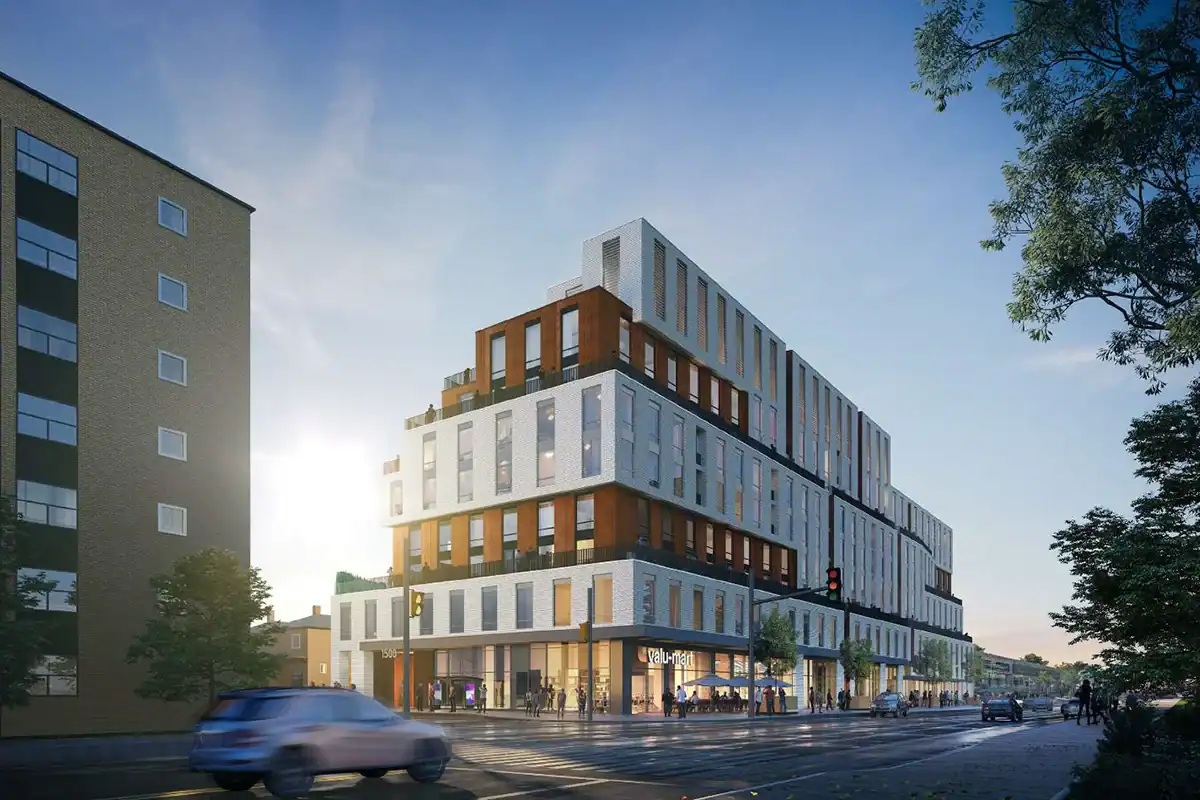
City Council directed City Planning to update the Official Plan and establish as-of-right zoning permissions to expand housing opportunities across the city. Building on that direction, the Avenues Policy Review modernizes policies and zoning to enable mid-rise buildings along Avenues.
On February 5, 2025, Council adopted Official Plan Amendment 778 (OPA 778), which comprehensively updated the Avenues policies, expanded the network of Avenues by 283 kilometres, and directed growth along Avenues generally to the height and scale of mid-rise buildings.
Phase Two of the Avenues Policy Review now moves from policy to implementation. It studies new and previously unexamined Avenues to determine where redesignation to Mixed Use Areas or Apartment Neighbourhoods is appropriate to enable mid-rise development.
On June 25, 2025, Council adopted the Phase Two Work Plan, launching an initial study of Ward 9 (Davenport) and Ward 11 (University-Rosedale) with final reporting in the fourth quarter of 2025. This report recommended redesignation of approximately 1,900 parcels along Avenues in these wards along with updates to the accompanying zoning advances Council’s goal of enabling mid-rise housing and complete communities.
Key aspects of the Avenues Policy Review in Wards 9 and 11
The first stage of the review includes Wards 9 and 11 , and these wards the initial focus of the study because of their many major transit corridors.
- Expanding Avenues: The plan proposes adding 283 kilometers of new avenues across the city, including streets like Ossington, Oakwood, Dufferin, and Lansdowne in Ward 9.
- Mid-rise and high-rise development: The policy aims to permit mid-rise buildings (up to 14 storeys) and high-rise buildings near subway stations as a matter of right, potentially without further studies.
- Zoning changes: The policy seeks to rezone or redesignate certain lands along avenues to allow for more mid-rise and high-rise development, and to allow for larger buildings near avenues.
- Community engagement: The City has held community open houses to get feedback from residents on these proposed changes within Ward 9 and Ward 11
What this means for the community
- Increased density: The changes are intended to increase housing supply in these areas.
- Transit-oriented development: The focus is on growth around major transit lines to encourage density and reduce car dependency.
- Simpler approvals: The policy aims to streamline the process for building mid-rise housing, which could lead to faster development.
Read the City Planning report for action for PH26.4 .
FoNTRA’s response to the Report
Toronto City Hall
100 Queen Street West
Toronto, ON M5H 2N2
Attention: Nancy Martins
RE: PH26.4 – Housing Action Plan: Avenues Policy Review Phase Two: Initial Study of Wards 9 and 11 Avenues
Dear Chair, Councillor Gord Perks, and Members of Planning and Housing Committee,
The Federation of North Toronto Residents Associations represents over 35 resident associations in North Toronto and North York, and works to bring forward a coordinated and informed perspective on the City’s land use and transportation issues affecting both the neighbourhoods and the City. The residents’ associations that make up FoNTRA believe that Toronto can and should achieve better development.
The report, dealing with Wards 9 and 11, represents the first stage in the implementation of the Avenues Policy Review to “modernize” policies and zoning to enable mid-rise buildings along Avenues. The report studies new and previously re- examined Avenues to determine where redesignation to Mixed Use Areas or Apartment Neighbourhoods with corresponding zoning is appropriate to enable mid- rise development.
The report is complex and detailed. It establishes a methodology and guidelines for examining Wards 9 and 11, and proceeding with analysis and direction for the other 23 wards. As such, this report is important and precedent-setting. In general, we support the direction, and appreciate the careful examination of planning issues leading to recommended decisions and the development of guidelines.
However, here are some issues we would like to raise:
- Protected/Major Transit Station Areas (P/MTSA) (page 5-6 of 24)
The Provincial approval of Official Plan Amendments for P/MTAs represents a major overreach of the City’s land use planning process that directly interfaces (conflicts?) with the Housing Action Plan Avenues policy. P/MTSA’s mandate minimum density, while Avenues mandate maximum densities! Coordination and integration of three key planning policy initiatives (i.e., P/MTSAs, Avenues, and EHON/Major Streets) is a priority need, together with authentic public engagement in these processes. And with a legislated time frame – with MTSAs you are dealing with a 9-month time frame, and with Avenues having a “phased” one-year process, and Major Streets as directed by City Council. - Avenues Policy Review Phase Two – Work Plan (page 7 of 24)
The process for implementation in other wards across the City is unclear. Will there continue to be a ward-by-ward approach of consultation and analysis and report back? Or will the remaining wards be grouped with city-wide consultation? We would like to see a clear, unambiguous commitment to a phased and Ward-engaged approach to the Phase 2 process going forward. - Application of Redesignation and Rezoning Guide (Version 1).
As noted above, in general, we support the application of the Guide as proposed. However, there are three matters which we object to:- Heritage Conservation (page 11 of 24)
The report notes that Rosedale Heritage Conservation District (i.e., designated under Part V under the Ontario Heritage Act) is recommended not to be re-designated to Mixed Use or Apartment Neighbourhoods but there is no reference to heritage designated properties (i.e., designated under Section IV of the Ontario Heritage Act).
We recommend that these properties be excluded also. - Shallow Lots with Frontage on Avenues (page 11 of 24)
“In instances where a lot depth is shallower than the ideal depth in the Midrise Guidelines, staff recommend extending the redesignation and rezoning to parcels behind the shallow parcel to enable a midrise building in accordance with the Mid-rise Building Design Guidelines.”
We strongly disagree with this proposal, which opens the opportunity for inappropriate incursions into internal neighbourhood streets, and due to the additional rear lands, will lead to pressure for much bigger and taller buildings than anticipated under the Mid-Rise Building Design Guidelines. - School Sites (page 14 of 24)
School sites were considered within the scoping and redesignation criteria, and the report recommends that two TDSB schools be re-designated to Apartment Neighbourhoods. No rationale for this recommendation is given.
Given the current Ontario government overreach of the TDSB and other school boards in replacing elected trustees with appointed “supervisors”, we worry about making these lands more “attractive” to the Ontario government. As such, we strongly disagree with this proposed re-designation of school lands.
- Heritage Conservation (page 11 of 24)
- Infrastructure Impacts of increased density (general)
While the report refers to Water and Wastewater Servicing (page 13 of 24), it lacks a clear strategy for investment required in public infrastructure, such as parks, schools, or servicing as a result of significant new density.
Finally, we note the link between Agenda items PH26.2 and PH26.4 (HAP – Avenues) and the importance of sidewalks and street trees in ensuring a pleasant, vibrant streetscape, and recommend that the Avenue setback requirements (above and below ground) be revisited to ensure sufficient space for sidewalks/bike lanes and a viable tree canopy.
Yours truly,
Geoff Kettel
Co-Chair, FoNTRA
CC: Jason Thorne, Chief Planner and Executive Director, City Planning
Valesa Faria, Executive Director, Development Review
Corwin Cambray, Director, Strategic Initiatives, Policy & Analysis, City Planning,
Kyle Knoeck, Director, Zoning, City Planning
Kyle Fearon, Project Manager, Strategic Initiatives, Policy & Analysis, City Planning
Valerie Maurizio, Senior Planner, Strategic Initiatives, Policy & Analysis, City Planning
Brooke Marshall, Senior Planner, Zoning, City Planning
Mary MacDonald, Senior Manager, Heritage Planning, City Planning